
Subscribe to our newsletter!
We don't spam. You will only receive relevant and important tips for you and your business.
Unsubscribe anytime.
By Darren DeYoung
If an agency writes your pages, you should be able to name the person doing it and see your own towns, crew and jobs in the copy. Pages that could belong to any company in any city are the tell. Here's what fake pages look like, and four questions that sort it out before you sign.

Some do.
AI makes it cheap to turn out dozens of service and city pages that read fine but say nothing about your company. Google says using AI is allowed. Its problem is pages built to game rankings without helping the reader, and that's what you're checking for when you look at an agency's work.
Google's own spam policies call it "scaled content abuse." One example they list: "Using generative AI tools or other similar tools to generate many pages without adding value for users."
Their guidance on AI content says "Appropriate use of AI or automation is not against our guidelines." So the tool isn't what you're judging. The page is.
If you want the deeper look at AI tools for running a business, we covered that in using AI to improve your small business operations. This post is about checking the agency.
They look like they could belong to any company in any city. Swap the logo and the town name and nothing else would need to change.
Watch for five signs: generic service copy, stock photos, no crew names, no real towns, and a pile of new pages that appeared overnight.
| The sign | What real looks like |
|---|---|
| Copy fits any city | Your streets, your jobs |
| Stock photos | Your crew, your trucks |
| No crew names | Crew and owner named |
| No real towns | Towns you drive to |
| 20 pages overnight | Pages built from interviews |
Read your tree removal page out loud. If it says "we serve the greater metro area with quality and care" and never mentions the oak wilt calls you get in Maplewood, nobody who knows your business wrote it.
When near-identical city pages exist only to rank and funnel people to one page, Google calls it doorway abuse. Its examples include "pages targeted at specific regions or cities that funnel users to one page."
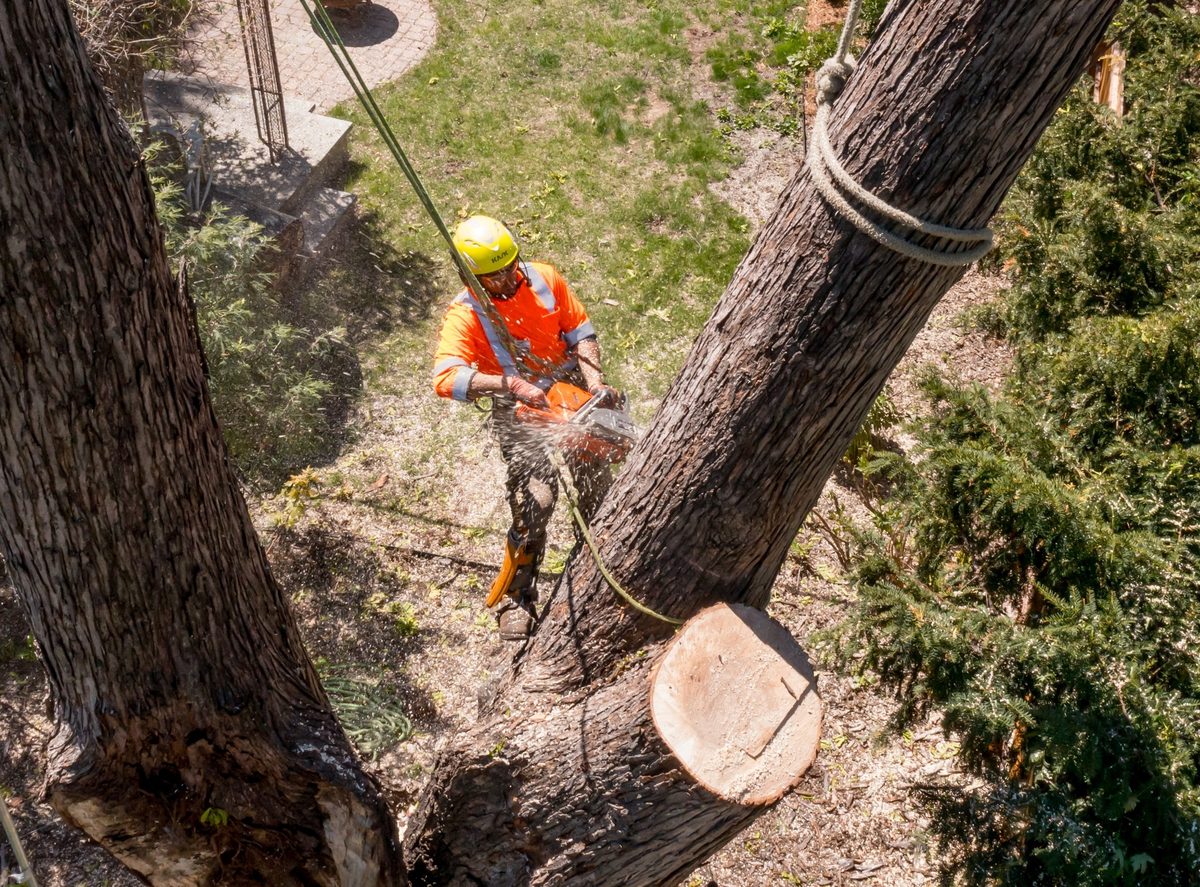 A Precision Landscape & Tree climber taking down a storm-damaged oak in Little Canada, MN
Your own shots of your trucks and crew also keep your branding consistent.
Real pages name people. The owner, the crew lead, the guy who's been running the stump grinder for eight years. Those are the same names homeowners mention in your Google reviews.
Real pages name the towns you actually drive to and the work you do there. Your Google Business Profile service area and your town pages should tell the same story.
If you're growing into new towns, each town page should say something only you could say about working there.
A writer who's talking to you can't produce 20 solid service pages between Tuesday and Wednesday. If your site grew that fast, ask who wrote them and what they asked you first.
Our 10-minute walkthrough of what customers see when they look you up shows you how to run that check.
Ask four things before you sign:
An agency doing the work answers all four without squirming.
Bring these to the first meeting. Our post on what to know before your first meeting with a web designer has more you can add to the list.
You want a name and a role. "Our content team" is a department, and it might be one person with a prompt.
Google's helpful content guidance asks the same thing of every site: "Is it self-evident to your visitors who authored your content?"
Ask for one paragraph about your actual service in one of your actual towns. A garage door repair page for Woodbury should read differently from one for Stillwater.
If the sample comes back with no questions asked, that tells you how your pages will be written.
Meet the writer before the contract, in person or on a call. Ask what they'd want to know about your business. Good writers ask about your best jobs, your worst callbacks, and why people pick you over the next truck.
Ask for three client sites. Pick a sentence from one service page, put it in quotes, and search it on Google.
If the same line shows up on a roofer in Ohio and a painter in Texas, you've found the template. It's the same gut check as how to spot a shady SEO offer. For more, see how to choose the right SEO company.
Proof from your own jobs.
An agency doing the work asks for your price ranges, how your estimates and permits work, and a real project with photos for each town you serve. Without those details, even an honest writer can only turn out general pages that sound like everyone else.
Town and service pages put your name in front of more of your service area. That's a fine start. To win the job, a page has to work like a buying guide.
A homeowner reading it wants to pick a solution, plan a budget and know what happens after they call. That takes facts only the business owner has. Specific facts help the person reading, and they give AI search tools something real to pull from too.
What a good agency asks you for:
The project per city matters most. One real job and one real review per town makes a big difference. Two or three is even better.
Here's the difference it makes. "We offer professional tree removal in Roseville" could be anyone. "Took down two storm-split oaks near Rice Street and County Road B, cleaned up and ground the stumps the same week" could only be you.
Google's helpful content guidance also asks whether your content shows "first-hand expertise and a depth of knowledge." Your own jobs are that first-hand proof.
If an agency never asks for any of this, they're writing your pages from a template. If they ask and you can't send it yet, start saving before and after photos on every job this week.
We use AI tools where they save time, like research and first drafts.
A person at Hoist who knows your trade decides what goes on your site and checks it against what you told us. Our pricing page says it plainly: "We Don't Use AI as a Crutch."
That line is on our pricing page, and it means what it says. A tool can help. It can't meet you, learn your towns or know which jobs you want more of.
Clients know who's doing the work by name.
That's from the Fra-Dor case study. Clients name Darren and Ryan because those are the people they talk to.
Our Results page shows the numbers those clients tracked at the time. A Garage Door And Gate Store was booked out six months after Hoist launched the company's Google Ads.
You can see everyone on the team on our Agency page. Hoist builds websites and runs marketing, so the people writing your pages also see which ones make the phone ring.
If an agency can't name the person who will write your pages, you already have the answer.
Ask the four questions in every pitch, including ours. Then pick the people who asked the most about your business.
Comparing more than one agency? Use our small local agency vs a bigger firm scorecard alongside these checks, and read before you sign a marketing contract.
Ask us who'd write yours. Book a time with Hoist, or come by the White Bear Lake office and meet us.