
Subscribe to our newsletter!
We don't spam. You will only receive relevant and important tips for you and your business.
Unsubscribe anytime.
By Jacquie

Garage door businesses operate in a high-intent, low-frequency market. Homeowners don't need a new garage door every year but when they do, they need it fast, they're often stressed, and they're searching on their phone. That changes everything about how you should market.
Most garage door leads come from one of three moments:
Each of these requires different marketing. The emergency repair customer is searching right now and will call the first trustworthy result they see. The replacement buyer is comparing options and reading reviews. The commercial customer needs a relationship and a track record.
The short answer: A fully optimized, verified Google Business Profile is the single most impactful free marketing action a garage door business can take. It determines whether you appear in the local map pack, the three results that appear above all organic results for searches like "garage door repair near me."
According to Birdeye's State of Google Business Profile report, verified profiles with complete data are 80% more likely to appear in local search results. Incomplete profiles don't just rank lower they're largely invisible.
Every field matters. Localo's analysis of over 2 million GBPs found that roughly 75% of businesses ranking in positions 1–3 had fully completed descriptions, compared to fewer than 40% of businesses ranking in positions 11–20.
For a garage door company specifically, prioritize:
The short answer: Most garage door businesses underinvest in review generation. Reviews directly affect both your local search ranking and whether a customer who finds you actually calls. Businesses with strong, recent review profiles measurably outperform competitors on revenue.
According to BrightLocal's Local Consumer Review Survey, 82% of consumers read Google reviews before engaging with a business. For a service like garage door repair where someone is letting a stranger into their home that number is almost certainly higher.
A few statistics worth understanding before you decide whether this is worth your time:
The simplest system: immediately after a completed job, text or email the customer a direct link to your Google review page. No intermediary step, no login wall. If your job management software allows automated follow-up, set it up. If not, make it a manual habit for your technicians.
A few things that work:
The short answer: Google Local Services Ads (LSAs) place your business above all paid and organic results at the very top of the page. You pay per lead, not per click, and only when a customer contacts you through the ad. For garage door companies, this is often the fastest way to generate inbound calls without waiting for SEO to kick in.
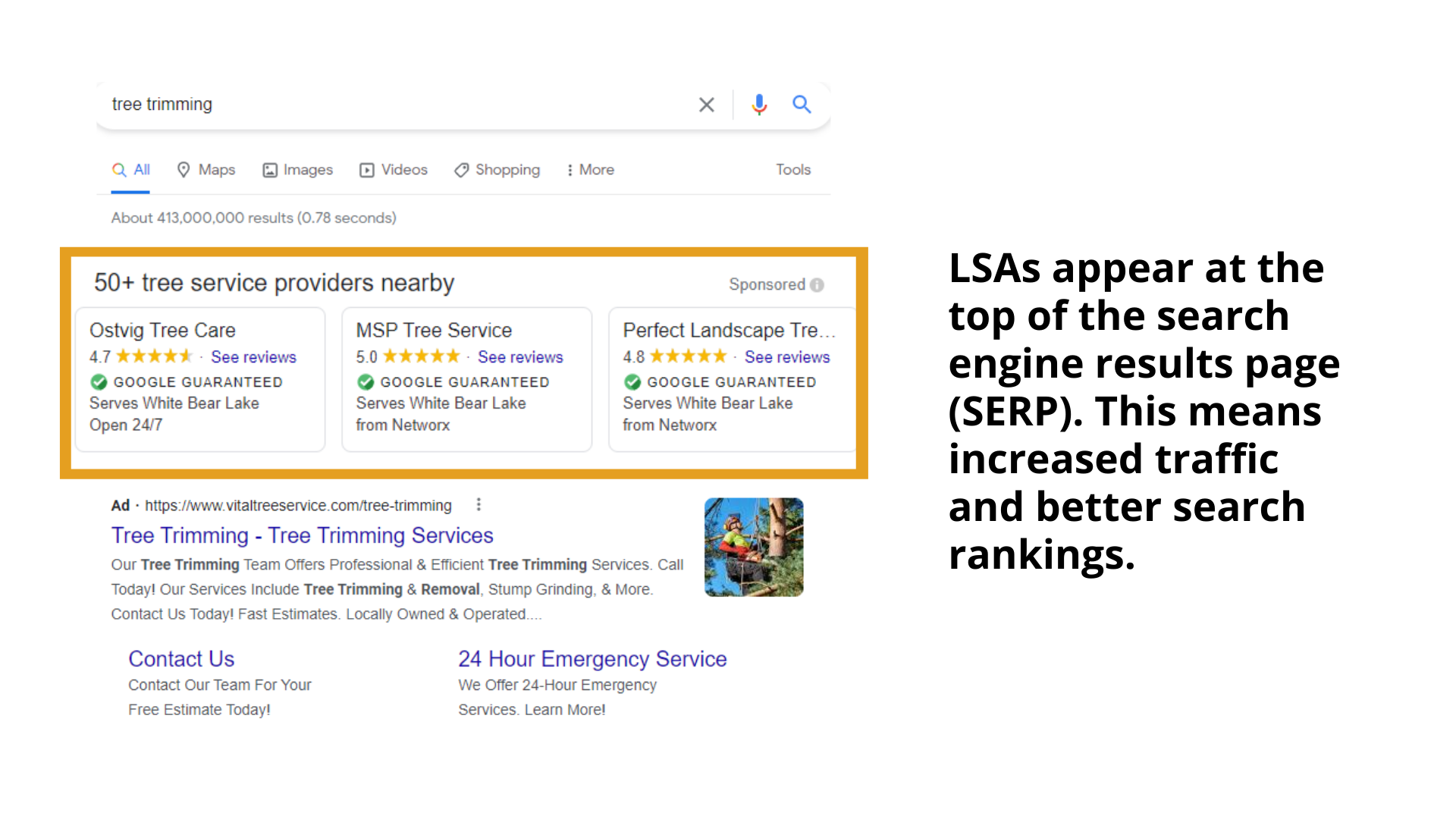
LSAs work differently from standard Google Ads. The key mechanics:
For a garage door business, high-value keywords captured by LSAs include terms like "garage door repair near me," "broken garage door spring," and "garage door installation." These are high-intent, near-purchase searches.
Paid search costs have increased significantly in recent years. Google Local Service Ads (LSAs) for garage door businesses are among the most expensive in the home services sector, with costs often ranging from $40 to over $100 per lead depending on location and competition.
Whether LSAs make sense financially depends on your average job value and close rate. If you convert 50% of inbound calls and your average job is $400, even a $80–100 cost per lead delivers strong ROI.
The short answer: SEO for a local garage door business means ranking your website in Google's organic results for searches your customers are already making and it takes 6–12 months to see meaningful results. When done well, it creates a compounding asset.
Keyword research for this vertical is not mysterious. Start with the searches your customers make when they have a problem:
Each of these deserves its own page on your website, not a single page trying to rank for all of them.
SEO can take time and patience is an SEO virtue. If you take the time to track everything, you'll see the results and be able to measure your SEO performance, like a boss.
Track your Google Search Console data to see which queries are driving impressions, and use that to guide what to optimize next.
The short answer: Content marketing works for garage door businesses by addressing the questions customers have before they're ready to call. A homeowner comparing repair vs. replacement, or trying to understand why their door is making a grinding noise, is a future customer. Useful content captures that intent and keeps your business top of mind.
Not all content is equally valuable. Focus on topics with clear search demand and decision-stage relevance:
Each of these topics is searchable, answerable, and leads naturally to a service you provide.
None of them require professional copywriting. A short, specific, accurate answer to a real question is more useful than a polished piece that never commits to an answer.
Evergreen content (like "how to choose a garage door opener") remains relevant indefinitely and continues driving traffic long after it's published. For a business with limited time for marketing, evergreen content is the highest-leverage content investment. Time-sensitive content (seasonal maintenance guides, new product announcements) has a shorter shelf life but can still drive traffic during relevant windows.
The short answer: For most garage door businesses, Facebook is the most relevant social platform because that's where your audience actually spends time. Nextdoor is a strong secondary channel for hyperlocal awareness. Instagram can work if you do visually striking work. TikTok has growing reach but a different demographic fit.
Pick one, show up consistently, and measure results before expanding.
The mistake most home service businesses make on social media is posting only promotional content. What actually performs:
Social media is primarily a brand awareness platform. It can provide ROI, but it is notoriously hard to attribute. Before spending money on social ads, build your organic presence and use it to understand what content your audience responds to.
If you're trying to decide where to begin, use this order:
This isn't a race. Each layer compounds the one before it. A business with a strong GBP, 40 reviews, and a well-optimized website will outperform a competitor running ads with none of those things in place often at a fraction of the cost.
Want help building a strategy that fits your market, your services, and your goals?