
Subscribe to our newsletter!
We don't spam. You will only receive relevant and important tips for you and your business.
Unsubscribe anytime.
By Ryan Boog

Google Ads is an auction-based advertising platform that places your business in front of people actively searching for what you offer. You select keywords, write ads, set a budget, and pay when someone clicks. Ads can appear on Google Search, Google Maps, YouTube, and millions of partner websites.
For small businesses, the appeal is straightforward: show up when someone searches "emergency plumber near me" or "best tax preparer in [city]" and pay only when they click and visit your website.
The problem isn't the platform. It's the gap between setting up an account and running a campaign that actually delivers a return.
Google actively encourages small business owners to manage their own ads. The platform offers guided setup wizards, pre-populated keyword suggestions, AI-generated ad copy, and "Smart Campaigns" that promise hands-off management.
Google earns revenue every time someone clicks an ad, whether or not that click becomes a customer. Their incentive is for you to spend; they care less about your conversion rate.
Auto-recommendations frequently push higher bids, broader keyword match types, and expanded targeting, all of which increase impressions and clicks without necessarily improving lead quality.
Bad ads don't just underperform, they cost money while doing it. Here are three failure patterns common in self-managed campaigns.
A single typo in an ad headline signals carelessness to potential customers and wastes every click that ad receives. Ads with spelling or grammatical errors consistently show lower click-through rates and quality scores, which also drives up your cost per click.
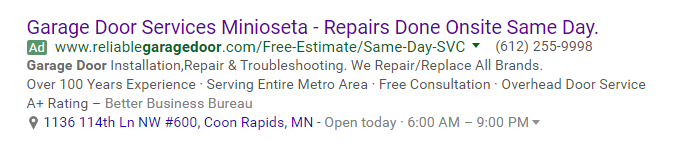 Mistake: Minioseta? Have you ever been to Minioseta? Me neither. Google doesn't catch spelling errors. But your competitors and potential customers do.
Google Ads allows advertisers to add sitelinks, callouts, location info, phone numbers, and structured snippets to ads at no extra cost. These extensions increase ad size, improve click-through rates, and give searchers more reasons to choose you before they even reach your website.
An ad that shows only a headline and two lines of description is leaving significant real estate, and likely significant revenue, on the table.

Mistake: No part of this ad is optimized. The only thing this company has is “Call Us Today”. This ad is missing out on explaining their services, qualifications, and offers. There is a lot of information that can be added.
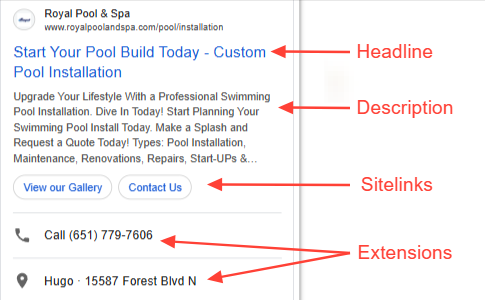
A well-constructed ad earns attention, communicates value, and filters for the right audience. Every part of a Google ad has a job. Here's what each one does.
Running Google Ads effectively requires decisions that never appear in a Smart Campaign dashboard.
Google offers three match types: broad, phrase, and exact. Broad match — the default — can show your ad for searches that are loosely related to your keyword.
A plumber bidding on "pipe repair" with broad match might show up for "pipe dream definition" or "PVC pipe wholesale."
Phrase and exact match give you control. They cost more per click in some cases, but the clicks convert better. Most beginner campaigns over-rely on broad match and wonder why their traffic doesn't turn into leads.
Negative keywords tell Google when not to show your ad. Without them, a local HVAC company might pay for clicks from people searching for DIY repair guides, job listings, or equipment wholesale, none of whom are potential customers.
Building a negative keyword list before launching a campaign, and adding to it weekly based on your search terms report, is standard practice in managed campaigns and almost universally skipped in DIY setups.
Sending paid traffic to your homepage is one of the most common and costly mistakes in Google Ads. Effective campaigns direct each ad group to a dedicated landing page that mirrors the ad's message, focuses on a single conversion action, and eliminates navigation distractions.
Google also uses landing page experience as part of its Quality Score algorithm — a measure that directly affects your cost per click.
A poor landing page means you pay more for every click than a competitor with a better page.
Most small businesses don't need to run ads 24/7 or nationally. Limiting ad delivery to business hours, specific zip codes, and radius targeting around your location focuses budget where it's most likely to convert.
These settings are available in standard campaigns but bypassed entirely in Smart Campaigns.
The question isn't whether Google Ads works for small businesses. It does.
The question is whether the return justifies the spend, and that depends almost entirely on how the campaign is built and managed.
A managed campaign isn't just setup. It's an ongoing process of testing, refinement, and optimization against actual business goals.
Typical scope of professional management:
Google Ads works best when:
If those conditions aren't in place, Google Ads spend will likely generate clicks, and little else.
Need an honest assessment of your current Google Ads account?